

-
121 line
линия; магистраль; трубопровод; провод; кривая; линейка ( ЛА на стоянке) ; стропа ( парашюта) ; рубеж ( зоны) ; облицовывать ( изнутри)45° climbing line — прямолинейный набор высоты под углом 45° к горизонту
45° diving line — прямолинейное пикирование под углом 45° к горизонту
90° climbing line — набор высоты на вертикали, прямолинейный отвесный подъём
90° diving line — прямолинейное отвесное пикирование
c/4 line — линия четвертей хорд
climbing line plus 45° angle from inverted flight with 1/2 roll to the right — набор высоты под углом 45° из горизонтального перевёрнутого полёта с выполнением правой полубочки в наборе и выходом в нормальный горизонтальный полет
climbing line plus 45° angle from inverted flight — набор высоты под углом 45° из перевёрнутого горизонтального полёта с выходом в перевёрнутый горизонтальный полет
climbing line plus 45° angle from normal flight with 1/2 roll to the right — набор высоты под углом 45° из нормального горизонтального полёта с выполнением правой полубочки в наборе и выходом в перевёрнутый горизонтальный полет
climbing line plus 45° angle from normal flight — набор высоты под углом 45° из нормального горизонтального полёта с выходом в нормальный горизонтальный полет
climbing line plus 45° angle — прямолинейный горизонтальный полет с переходом в набор высоты под углом 45° (к горизонту) и выходом в горизонтальный полет
come on the line — вступать в действие; подключаться к системе
diving line plus 45° angle from inverted flight with 1/2 roll to the right — пикирование под углом 45° из горизонтального перевёрнутого полёта с выполнением правой полубочки на снижении и выходом в нормальный горизонтальный полет
diving line plus 45° angle from inverted flight — пикирование под углом 45° из перевёрнутого горизонтального полёта с выходом в перевёрнутый горизонтальный полет
diving line plus 45° angle from normal flight with 1/2 roll to the right — пикирование под углом 45° из нормального горизонтального полёта с выполнением правой полубочки на снижении и выходом в перевёрнутый горизонтальный полет
diving line plus 45° angle from normal flight — пикирование под углом 45° из нормального горизонтального полёта с выходом в нормальный горизонтальный полет
diving line plus 45° angle — прямолинейный горизонтальный полет с переходом в пикирование под углом 45° к горизонту и выходом в горизонтальный полет
interconnecting line of sight — линия прицеливания «станция наведения — цель»
line plus 135° angles — прямолинейный полет с двумя изменениями направления на 135° (горизонтальный полет, поворот в вертикальной плоскости на угол 135°, движение под углом 45° к горизонту, поворот в вертикальной плоскости на угол 135° и выход в горизонтальный полет)
line plus 45° angles — прямолинейный полет с двумя изменениями направления на 45° в вертикальной плоскости
line plus 90° angles — прямолинейный полет с двумя изменениями направления на 90° (горизонтальный полет, переход на вертикаль и выход в горизонтальный полет)
pilot's line of vision — линия визирования [направление взгляда] лётчика
propellant tank discharge line — ркт. трубопровод отвода [отбора] топлива из бака
— air line— hot line— line up— red line -
122 Carroll, Thomas
SUBJECT AREA: Agricultural and food technology[br]b. 1888 Melbourne, Victoria, Australiad. 22 February 1968 Australia[br]Australian engineer responsible for many innovations in combine-harvester design, and in particular associated with the Massey Harris No. 20 used in the "Harvest Brigade" during the Second World War.[br]Carroll worked first with the Buckeye Harvester Co., then with J.J.Mitchell \& Co. In 1911 he was hired by the Argentinian distributor for Massey Harris to help in the introduction of their new horse-drawn reaper-thresher. Carroll recommended modifications to suit Argentinian conditions, and these resulted in the production of a new model. In 1917 he joined the Toronto staff of Massey Harris as a product design leader, the No. 5 reaper-thresher being the first designed under him. Many significant new developments can be attributed to Carroll: welded sections, roller chains, oil-bath gears, antifriction ball bearings and the detachable cutting table allowing easy transfer of combines between fields were all innovations of which he was the source.In the 1930s he became Chief Engineer with responsibility for the design of a self-propelled harvester. The 20 SP was tested in Argentina only eight months after design work had begun, and it was to this machine that the name "combine harvester" was applied for the first time. Improvements to this original design produced a lighter 12 ft (3.65 m) cut machine which came off the production line in 1941. Three years later 500 of these machines were transported to the southern United States, and then gradually harvested their way northwards as the corn ripened. It has been estimated that the famous "Harvest Brigade" harvested over 1 million acres, putting 25 million bushels into store, with a saving in excess of 300,000 labour hours and half a million gallons of fuel.Carroll retired from Massey Ferguson in 1961.[br]Principal Honours and DistinctionsAmerican Society of Agricultural Engineers C.H. McCormick Gold Medal 1958.Bibliography1948, "Basic requirements in the design and development of the self propelled combine"Agricultural Engineer. 29(3), 101–5.Further ReadingG.Quick and W.Buchele, 1978, The Grain Harvesters, American Society of Agricultural Engineers (provides a detailed account of the development of the combine harvester).K.M.Coppick, 1972, gave an account of the wartime effort, which he mistakenly called "Massey Ferguson Harvest Brigade", presented to the Canadian Society forAgricultural Engineers, Paper 72–313.AP -
123 Reichenbach, Georg Friedrich von
SUBJECT AREA: Mechanical, pneumatic and hydraulic engineering, Photography, film and optics, Public utilities[br]b. 24 August 1772 Durlach, Baden, Germanyd. 21 May 1826 Munich, Germany[br]German engineer.[br]While he was attending the Military School at Mannheim, Reichenbach drew attention to himself due to the mathematical instruments that he had designed. On the recommendation of Count Rumford in Munich, the Bavarian government financed a two-year stay in Britain so that Reichenbach could become acquainted with modern mechanical engineering. He returned to Mannheim in 1793, and during the Napoleonic Wars he was involved in the manufacture of arms. In Munich, where he was in the service of the Bavarian state from 1796, he started producing precision instruments in his own time. His basic invention was the design of a dividing machine for circles, produced at the end of the eighteenth century. The astronomic and geodetic instruments he produced excelled all the others for their precision. His telescopes in particular, being perfect in use and of solid construction, soon brought him an international reputation. They were manufactured at the MathematicMechanical Institute, which he had jointly founded with Joseph Utzschneider and Joseph Liebherr in 1804 and which became a renowned training establishment. The glasses and lenses were produced by Joseph Fraunhofer who joined the company in 1807.In the same year he was put in charge of the technical reorganization of the salt-works at Reichenhall. After he had finished the brine-transport line from Reichenhall to Traunstein in 1810, he started on the one from Berchtesgaden to Reichenhall which was an extremely difficult task because of the mountainous area that had to be crossed. As water was the only source of energy available he decided to use water-column engines for pumping the brine in the pipes of both lines. Such devices had been in use for pumping purposes in different mining areas since the middle of the eighteenth century. Reichenbach knew about the one constructed by Joseph Karl Hell in Slovakia, which in principle had just been a simple piston-pump driven by water which did not work satisfactorily. Instead he constructed a really effective double-action water-column engine; this was a short time after Richard Trevithick had constructed a similar machine in England. For the second line he improved the system and built a single-action pump. All the parts of it were made of metal, which made them easy to produce, and the pumps proved to be extremely reliable, working for over 100 years.At the official opening of the line in 1817 the Bavarian king rewarded him generously. He remained in the state's service, becoming head of the department for roads and waterways in 1820, and he contributed to the development of Bavarian industry as well as the public infrastructure in many ways as a result of his mechanical skill and his innovative engineering mind.[br]Further ReadingBauernfeind, "Georg von Reichenbach" Allgemeine deutsche Biographie 27:656–67 (a reliable nineteenth-century account).W.Dyck, 1912, Georg v. Reichenbach, Munich.K.Matschoss, 1941, Grosse Ingenieure, Munich and Berlin, 3rd edn. 121–32 (a concise description of his achievements in the development of optical instruments and engineering).WKBiographical history of technology > Reichenbach, Georg Friedrich von
-
124 characteristic
n1) мн. технічні дані2) військ. тактико-технічні дані◊•- acceleration characteristic of fuel - acceleration characteristics - aerodynamic characteristics - aeroelastic characteristics - aircraft performance characteristics - air flow characteristic - basic characteristics - combustion characteristic - control characteristic - decay characteristic - design characteristic - directional stability characteristic - drainage characteristics - elevation characteristic - excessive sound absorption characteristic - fail-safe characteristic - flight characteristics - flow characteristic - generalized noise characteristics - handling characteristic - hazardous characteristics - landing characteristics - lateral characteristic - manifold pressure characteristic - noise characteristics - noise source characteristic - no-load characteristic - onset characteristics - operating characteristic - operational characteristic - pressure response characteristic - propulsion performance characteristics - runway friction characteristic - sound emission characteristic - specified characteristics - spectral characteristic - spin-recovery characteristics - stability characteristic - stall characteristic - stalling characteristic - surge characteristic - take-off and landing characteristics - throttle characteristic - thrust characteristic - track-defining characteristics - trim characteristic - turn characteristics - vibration characteristicEnglish-Ukrainian dictionary of aviation terms > characteristic
-
125 ST
- язык ST
- член уравнения, соответствующий источнику нейтронов
- установившийся
- температура размягчения (золы)
- температура поверхности
- таблица байтов стаффинга
- сигнал окончания набора номера
- разъем типа ST
- начало
- критерий конвективного переноса тепла
- короткая тонна
- испытания системы
- информация о состоянии (функциональная связь)
- бак-приямок отстойный резервуар
бак-приямок отстойный резервуар
—
[А.С.Гольдберг. Англо-русский энергетический словарь. 2006 г.]Тематики
EN
информация о состоянии (функциональная связь)
—
[ ГОСТ Р 54325-2011 (IEC/TS 61850-2:2003)]]Тематики
EN
критерий конвективного переноса тепла
число Стэнтона
Является мерой отношения интенсивности теплоотдачи и удельного теплосодержания потока
[А.С.Гольдберг. Англо-русский энергетический словарь. 2006 г.]Тематики
Синонимы
EN
начало
—
[Е.С.Алексеев, А.А.Мячев. Англо-русский толковый словарь по системотехнике ЭВМ. Москва 1993]Тематики
EN
- start
- ST
разъем типа ST
Кабельный разъем, обеспечивающий торцевое соединение волокон и фиксацию с помощью соединителя байонетного типа (ISO/IEC 11801).
[ http://www.iks-media.ru/glossary/index.html?glossid=2400324]
разъем ST
Предложенный компанией AT&T байонетный разъем для подключения оптических кабелей. Разъемы ST обеспечивают прецизионные керамические вставки и гибкие соединения с кабелем. См. также SC connector.
[ http://www.lexikon.ru/dict/net/index.html]
ST
Тип волоконно-оптической вилки или адаптера байонетного типа
[Дмитрий Мацкевич. Справочное руководство. Основные понятия, требования, рекомендации и правила проектирования и инсталляции СКС LANMASTER. Версия 2.01]Тематики
- СКС (структурированные кабельные системы)
- сети вычислительные
- электросвязь, основные понятия
EN
сигнал окончания набора номера
—
[Л.Г.Суменко. Англо-русский словарь по информационным технологиям. М.: ГП ЦНИИС, 2003.]Тематики
EN
температура поверхности
поверхностная температура
—
[А.С.Гольдберг. Англо-русский энергетический словарь. 2006 г.]Тематики
Синонимы
EN
температура размягчения (золы)
—
[А.С.Гольдберг. Англо-русский энергетический словарь. 2006 г.]Тематики
EN
установившийся
стационарный
(напр. о режиме, теплообмене и др.)
[А.С.Гольдберг. Англо-русский энергетический словарь. 2006 г.]Тематики
Синонимы
EN
член уравнения, соответствующий источнику нейтронов
—
[А.С.Гольдберг. Англо-русский энергетический словарь. 2006 г.]Тематики
EN
язык ST
Структурированный текст. Один из пяти стандартизированных языков программирования ПЛК.
[ http://kazanets.narod.ru/PLC_PART2.htm]Язык ST (Structured Text, Структурированный Текст) представляет собой язык высокого уровня, имеющий черты языков Pascal и Basic. Данный язык имеет те же недостатки, что и IL, однако они выражены в меньшей степени. Пример программы на языке ST приведен на рис. 4.
С помощью ST можно легко реализовывать арифметические и логические операции (в том числе, побитовые), безусловные и условные переходы, циклические вычисления; возможно использование как библиотечных, так и пользовательских функций. Язык также интерпретирует более 16 типов данных.
Язык ST может быть освоен технологом за короткий срок, однако текстовая форма представления программ служит сдерживающим фактором при разработке сложных систем, так как не дает наглядного представления ни о структуре программы, ни о происходящих в ней процессах.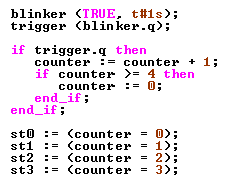
Рис. 4. Язык структурированного текста ST.[ http://kazanets.narod.ru/PLC_PART2.htm]
Тематики
EN
3.1.41 таблица байтов стаффинга (Staffing Table; ST): Таблица, применяемая для замены или отмены существующих секций или таблиц SI.
Источник: ГОСТ Р 53531-2009: Телевидение вещательное цифровое. Требования к защите информации от несанкционированного доступа в сетях кабельного и наземного телевизионного вещания. Основные параметры. Технические требования оригинал документа
Англо-русский словарь нормативно-технической терминологии > ST
-
126 externality
баланс интересов личности и общества
—
[ http://www.eionet.europa.eu/gemet/alphabetic?langcode=en]EN
externality
Discrepancies between private costs and social costs or private advantages and social advantages; the basic concept of externality is interdependence without compensation. (Source: PHC / GILP96 / GREENW)
[http://www.eionet.europa.eu/gemet/alphabetic?langcode=en]Тематики
EN
DE
FR
внешний эффект
экстерналия
Вид дополнительной экономии или дополнительных издержек, который не зависит от деятельности данного предприятия, но влияет на ее результаты. Например, одним из важнейших видов В.э. являются технологические воздействия, связанные с загрязнениями окружающей среды и нарушающие конкурентное равновесие на рынке.
[ОАО РАО "ЕЭС России" СТО 17330282.27.010.001-2008]Тематики
Синонимы
EN
ущерб в результате действия экзогенных факторов
—
[А.С.Гольдберг. Англо-русский энергетический словарь. 2006 г.]Тематики
EN
Англо-русский словарь нормативно-технической терминологии > externality
-
127 biodiversity
биоразнообразие
—
[ http://www.eionet.europa.eu/gemet/alphabetic?langcode=en]EN
biodiversity
1) Genetic diversity: the variation between individuals and between populations within a species; species diversity: the different types of plants, animals and other life forms within a region; community or ecosystem diversity: the variety of habitats found within an area (grassland, marsh, and woodland for instance. 2) An umbrella term to describe collectively the variety and variability of nature. It encompasses three basic levels of organisation in living systems: the genetic, species, and ecosystem levels. Plant and animal species are the most commonly recognized units of biological diversity, thus public concern has been mainly devoted to conserving species diversity. (Source: WRES / GILP96)
[http://www.eionet.europa.eu/gemet/alphabetic?langcode=en]Тематики
EN
DE
FR
Англо-русский словарь нормативно-технической терминологии > biodiversity
-
128 soil moisture
влажность почвогрунта
Содержание воды в почвогрунте.
Примечание
Различают: весовую влажность, которая выражается в процентах от веса абсолютно сухого почвогрунта или в процентах от веса сырого почвогрунта; объемную влажность - количество воды в почвогрунте, выраженное отношением объема воды к объему почвогрунта.
[ ГОСТ 19179-73]Тематики
Обобщающие термины
EN
DE
FR
влажность почвы
—
[ http://www.eionet.europa.eu/gemet/alphabetic?langcode=en]EN
soil moisture
1) Water stored in soils.
2) One of the most important elements involved in pedological processes and plant growth. There are three basic forms:
a) water adhering in thin films by molecular attraction to the surface of soil particles and not available for plants is termed hygroscopic water.
b) Water forming thicker films and occupying the smaller pore spaces is termed capillary water. Since it is held against the force of gravity it is permanently available for plant growth and it is this type of soil water which contains plant nutrients in solution.
c) Water in excess of hygroscopic and capillary water is termed gravitational water, which is of a transitory nature because it flows away under the influence of gravity. When the excess has drained away the amount of water retained in the soil is termed its field capacity, when some of its pore spaces are still free of water.
(Source: LANDY / DUNSTE)
[http://www.eionet.europa.eu/gemet/alphabetic?langcode=en]Тематики
EN
DE
FR
Англо-русский словарь нормативно-технической терминологии > soil moisture
См. также в других словарях:
BASIC — This article is about the programming language. For the think tank, see British American Security Information Council. For the group of countries, see BASIC countries. For other uses, see Basic (disambiguation). BASIC Screenshot of Atari BASIC,… … Wikipedia
source — 01. The [source] of the river is somewhere in the mountains. 02. His heavy drinking is the [source] of all his problems. 03. The BBC is the official [source] of news in England. 04. The main [source] of jobs for teenagers in this town during the… … Grammatical examples in English
BASIC-PLUS — was an extended dialect of the BASIC programming language developed by Digital Equipment Corporation (DEC) for use on its RSTS/E time sharing operating system for the PDP 11 series of 16 bit minicomputers in the early 1970s through the… … Wikipedia
BASIC 8 — (or BASIC 8.0) mdash; The Enhanced Graphics System For The C128 mdash; developed by Walrusoft of Gainesville, Florida and published in 1986 by Patech Software of Somerset, New Jersey, USA, was an extension of Commodore s BASIC 7.0 for the C128… … Wikipedia
Basic (langage) — BASIC Pour les articles homonymes, voir Basic. {{{image}}} Sigles d une seule lettre Sigles de deux lettres Sigles de trois lettres … Wikipédia en Français
Basic Input-Output System — Pour l’article homonyme, voir BIOS. Le Basic Input Output System ou BIOS (système élémentaire d entrée/sortie) est, au sens strict, un ensemble de fonctions, contenu dans la mémoire morte (ROM) de la carte mère d un ordinateur lui… … Wikipédia en Français
Basic input output system — Pour l’article homonyme, voir BIOS. Le Basic Input Output System ou BIOS (système élémentaire d entrée/sortie) est, au sens strict, un ensemble de fonctions, contenu dans la mémoire morte (ROM) de la carte mère d un ordinateur lui… … Wikipédia en Français
Source lines of code — (SLOC) is a software metric used to measure the size of a software program by counting the number of lines in the text of the program s source code. SLOC is typically used to predict the amount of effort that will be required to develop a program … Wikipedia
Source evaluation — is the skill of analysing information sources in order to assess their credibility. The ability to assess different sources of information is highly relevant to the task of operating within a complex information society.Engeldinger (1998) uses… … Wikipedia
Basic Linear Algebra Subprograms — (BLAS) is a de facto application programming interface standard for publishing libraries to perform basic linear algebra operations such as vector and matrix multiplication. They were first published in 1979, and are used to build larger packages … Wikipedia
Basic PDP-1 LISP — est une implémentation du langage de programmation Lisp pour machines PDP 1 développée par L. Peter Deutsch au début des années 1960. Basic PDP 1 LISP fonctionnait sous l émulateur SIMH. Voir aussi Articles connexes Machine Lisp Liens externes… … Wikipédia en Français
